What Are ELV Systems? Full Form, Meaning and List
What ELV stands for, which systems count as ELV, how they work together and which ones your office, villa, shop or warehouse actually needs.
ELV full form and meaning
ELV stands for Extra Low Voltage. The ELV meaning in electrical terms is a supply that does not exceed 50 volts AC or 120 volts ripple-free DC, the limit set by the international IEC standards. At that level the risk of a dangerous electric shock is very low.
In UAE buildings, people use "ELV" for something wider: the group of low-current systems that carry data, video, voice and control signals rather than heavy power. CCTV, access control, network cabling, Wi-Fi and phone systems are all ELV. Many of these devices take their power through the network cable itself, which is called PoE (Power over Ethernet), so a camera or a desk phone often needs no separate power socket.
How ELV differs from the rest of the wiring
A building has three voltage levels, and different people install each one.
| Level | Typical voltage | What it runs | Who installs it |
|---|---|---|---|
| ELV (Extra Low Voltage) | Up to 50 V AC or 120 V DC | Cameras, card readers, data points, Wi-Fi, desk phones | An ELV or IT and security installer |
| LV (Low Voltage) | Above ELV, up to 1,000 V AC | Sockets, lights, air conditioning, the distribution board | A licensed electrical contractor |
| HV and MV (High and Medium Voltage) | Above 1,000 V AC | Substations and the supply into the building | The utility and specialist contractors |
ELV systems list: what is included
These are the systems most UAE projects group under ELV. Not every building needs all of them.
| System | What it does |
|---|---|
| CCTV | Records and shows video of entrances, stock and work areas, viewable on your phone |
| Access control | Opens doors by card, fingerprint or face, or PIN, and logs who entered and when |
| Time attendance | Records staff check-in and check-out for payroll |
| Structured cabling and networking | The Cat6 or fibre backbone, patch panels and switches that every other system runs on |
| Wi-Fi | Wireless coverage for staff, guests and smart devices |
| PABX and IP phones | Desk phones, extensions, transfers and the reception line (what a PABX system is) |
| Intercom and video door phones | Lets a visitor at the gate or door talk to someone inside |
| Public address and background music | Announcements and music through ceiling speakers |
| Fire alarm and voice evacuation | Detects fire and guides people out. In the UAE this is regulated by Civil Defence and needs an approved fire contractor |
| Building management (BMS) and IPTV | Controls cooling, lighting and TV distribution in larger buildings |
Which ELV systems does your property need?
A starting point, not a rule. The layout, the number of staff and any rules for your type of business change the answer.
| Property | Usually needed | Often added |
|---|---|---|
| Office | Structured cabling, Wi-Fi, PABX or IP phones, access control | CCTV at the entrance, time attendance |
| Villa | Wi-Fi across every floor, CCTV for gates and parking | Video door phone, network rack in a cupboard |
| Shop or showroom | CCTV covering the till and the stock | Wi-Fi for card machines, background music |
| Warehouse or yard | CCTV for gates, loading bays and the yard, time attendance | Access control on stores, Wi-Fi for scanners |
| Clinic | Structured cabling, phones, access control on medicine and records rooms | CCTV at reception, queue display screens |
| Restaurant or cafe | CCTV for the till and kitchen door, guest Wi-Fi | Background music, staff attendance |
In Dubai, CCTV for many commercial premises must follow SIRA rules on cameras, coverage and recording, so check what applies to your business before you buy.
One network, many systems
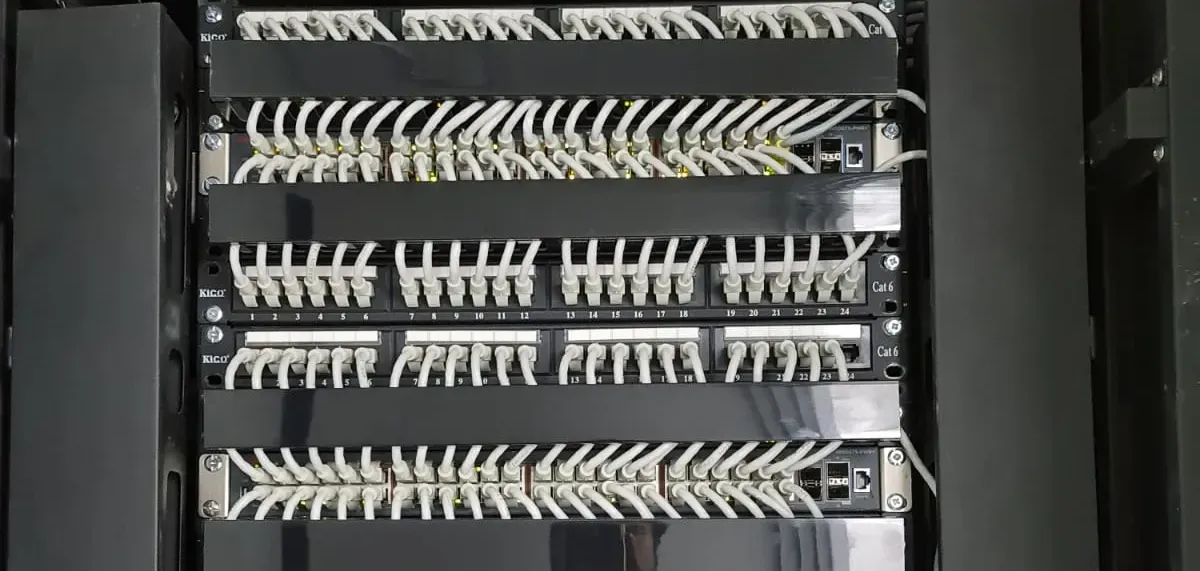
Modern ELV systems share the same cabling and rack instead of running separately, which is cheaper to install and easier to look after.
What is an ELV room? A fit-out checklist
An ELV room, or a smaller rack cupboard, is where the cabling, switches and recorders meet. Plan it before the ceilings and walls are closed, because moving it later means new cable runs.
Cooling and ventilation
Switches and recorders run all day. A closed cupboard in a Dubai summer needs airflow or its own cooling.
Dedicated power and a UPS
A separate circuit and a UPS keep cameras recording and phones working through a short power cut.
Separate from power cables
Data cables should run in their own containment, apart from power cables, to avoid interference and make future work safer.
Labels at both ends
Every point labelled at the desk and at the patch panel saves hours when something stops working.
A lock on the door
The room holds your recordings and network, so it deserves access control or at least a key holder list.
Room to grow
Leave spare space in the rack and spare cable points for the next desk, camera or access point.
How big should an ELV room be?
It depends on how much equipment has to fit, not on a fixed rule. As a starting point:
- Small office, shop or villa: a wall-mounted cabinet in a ventilated cupboard is often enough for the patch panel, switch, recorder and router.
- Medium office or clinic: one floor-standing rack in a small room, with space to open the rack doors and work behind it.
- Large or multi-floor buildings: a main ELV room plus a smaller rack on each floor, linked by a backbone cable.
An ELV room is not quite the same as a server room. The ELV room is where the building's low-current cabling meets; a server room holds servers and storage. In smaller offices the two are often the same room. For a full plan, see our server room setup checklist.
What an ELV company does, and what we install
An ELV company plans, supplies, installs and maintains the low-current systems in a building, ideally as one job, so the cameras, door readers, phones and Wi-Fi all share one well-built network and one rack.
As an ELV company in Dubai, Apex GenZ installs:
- Structured cabling and networking, the base for every other system.
- CCTV surveillance systems, Hikvision and Dahua.
- Access control and time attendance.
- Wi-Fi and PABX phone systems.
Fire alarm, public address and building management are specialist trades with their own approvals and are handled by approved contractors. Site visits in Dubai are free, Deira and Sharjah get same-day visits, and we cover the other emirates by appointment, including CCTV camera installation in Abu Dhabi.
Questions to ask an ELV contractor
Whoever you choose, these questions show quickly whether a quote has been thought through.
- Does your trade licence cover this work?
- Can I see the brand and model of every item?
- Will you survey the site before quoting?
- Who handles approvals such as SIRA or Civil Defence?
- Will the cabling be tested, labelled and documented?
- Who do I call after handover?
If you want one team to plan and install these systems together, see our page for an ELV company in Dubai.
ELV questions, answered
What is the full form of ELV?
The full form of ELV is Extra Low Voltage. An ELV room, often called the IT or comms room, is the room that holds the racks, switches, recorders and panels for CCTV, access control, data and phone systems.
What does ELV mean?
ELV means Extra Low Voltage: a supply of no more than 50 volts AC or 120 volts DC. In buildings it also names the group of low-current systems such as CCTV, access control, data cabling and phones.
What is ELV in CCTV?
CCTV is one of the main ELV systems. IP cameras run on low voltage, usually powered through the network cable from a PoE switch, and send their video to a recorder in the ELV rack.
Is a fire alarm an ELV system?
Yes, fire alarm and voice evacuation systems work at extra low voltage. In the UAE they are regulated separately by Civil Defence and must be installed and maintained by an approved fire contractor.
Is ELV the same as low voltage?
No. Low voltage (LV) is the normal building supply up to 1,000 volts AC that runs sockets and lighting. ELV is the much lower level below 50 volts AC used by data, security and communication systems.
What is an ELV room?
It is the room or cupboard where the ELV cabling meets the patch panels, switches, recorders and phone system. It needs cooling, its own power and a locked door.
Do ELV cables need to be kept apart from power cables?
Yes. Data and security cables should run in their own containment, separate from power cables, to avoid interference and to keep later work safe. Follow the separation set in your project's specification.
Is an ELV room the same as a server room?
Not exactly. An ELV room is where the low-current cabling for CCTV, access control, data and phones meets the patch panels and switches. A server room holds servers and storage. In small offices one room often does both jobs, but it then needs enough cooling and power for the servers too.
What does an ELV company do?
An ELV company plans, supplies, installs and maintains extra-low-voltage systems such as structured cabling, CCTV, access control, time attendance, Wi-Fi and phone systems, so they work together on one network. Fire alarm and public address systems are usually handled by specialist approved contractors.
Related pages
Apex GenZ on Google Maps
See our verified Google Business Profile, read what our customers say about our CCTV, networking and IT work, and leave a review after your job.
Planning ELV for an office, villa or fit-out?
Tell us the property and what you need it to do, and we will suggest the systems that fit.