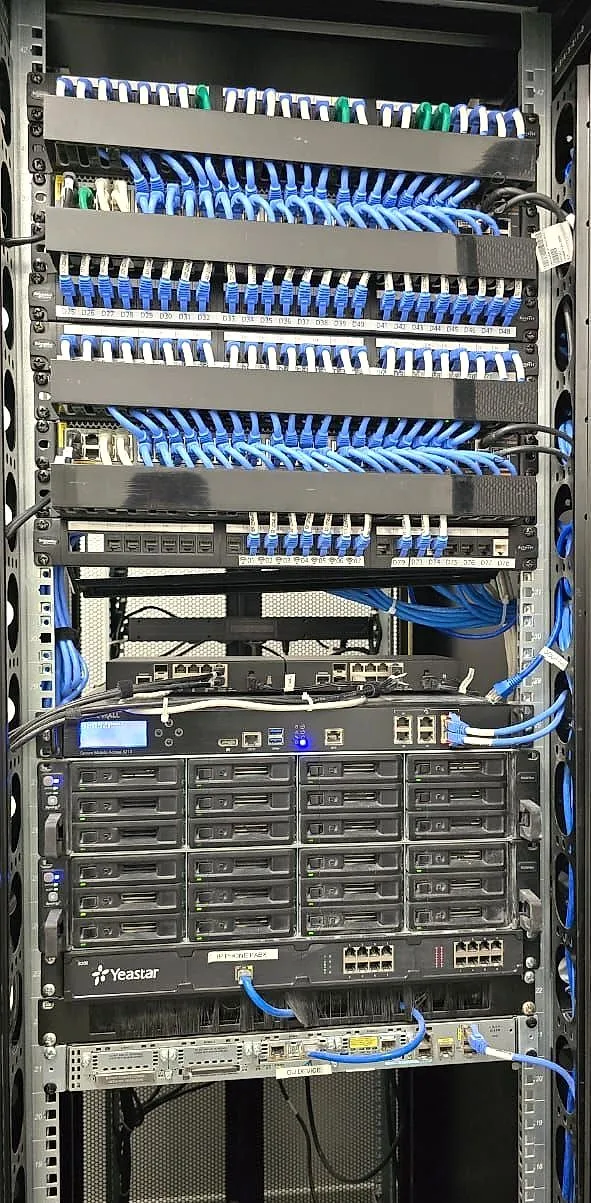
1. Lines come in
Outside lines from your telecom provider, du or e&, arrive as traditional lines or as SIP trunks over the internet connection.
What PABX means, how an office phone system works and how to tell if your business needs one.

PABX stands for Private Automatic Branch Exchange. It is a private telephone exchange for your business: it connects every desk phone inside the office as an extension and lets them share a small number of outside lines. Staff call each other free by dialling an extension, calls can be transferred, and customers can reach the whole company on one main number.
You will also see the term PBX (Private Branch Exchange). Today the two names mean the same thing. The "automatic" in PABX dates from the time when calls were connected by hand at a switchboard.
Outside lines from your telecom provider, du or e&, arrive as traditional lines or as SIP trunks over the internet connection.
The system plays a greeting, follows your office-hours rules and sends each call to the right person, group or voicemail.
Calls reach desk IP phones, cordless DECT handsets or a softphone app on a computer, and can be transferred between them.
| Type | How it works | Best for |
|---|---|---|
| Analog PABX | A box in the office with telephone cabling to simple analog phones | Older sites that already have it and only need basic calling |
| IP PBX | A system in your office that runs over the computer network, with IP phones powered by the network cable (PoE) | Most offices today: more features, easy to add extensions, works with existing network cabling |
| Cloud PBX | The system is hosted by a provider and the phones connect over the internet | Small or spread-out teams that prefer a monthly service and no equipment on site |
Common features include extensions for every person or desk, a welcome greeting with options ("press 1 for sales"), ring groups so several phones ring together, call transfer and hold music, voicemail sent to email, call recording, separate rules for office hours and holidays, and conference calls.
A phone system is worth considering when calls are often missed, when more than a few people answer the phone, when customers should reach the whole company on one number, or when you have several rooms, floors or branches. A small office with one or two staff can often manage with mobile phones until it grows.
PABX stands for Private Automatic Branch Exchange: a private telephone exchange that connects the phones inside a business and shares outside lines between them.
Today there is no practical difference and the names are used for the same thing. The word automatic was added when exchanges stopped needing an operator to connect calls by hand.
An IP PBX is a system installed in your office that runs over your own network. A cloud PBX is hosted by a provider and paid monthly. Both use IP phones; the difference is where the system lives and who manages it.
Usually yes. Your number stays with your telecom provider and is connected to the new phone system, so customers keep calling the same number.
It depends on how many calls happen at the same time, not on the number of staff. Many small offices share a few lines between all their extensions. We can check your call pattern and suggest the right number.
Tell us how many people answer calls and how your office is laid out, and we will recommend a system that fits.